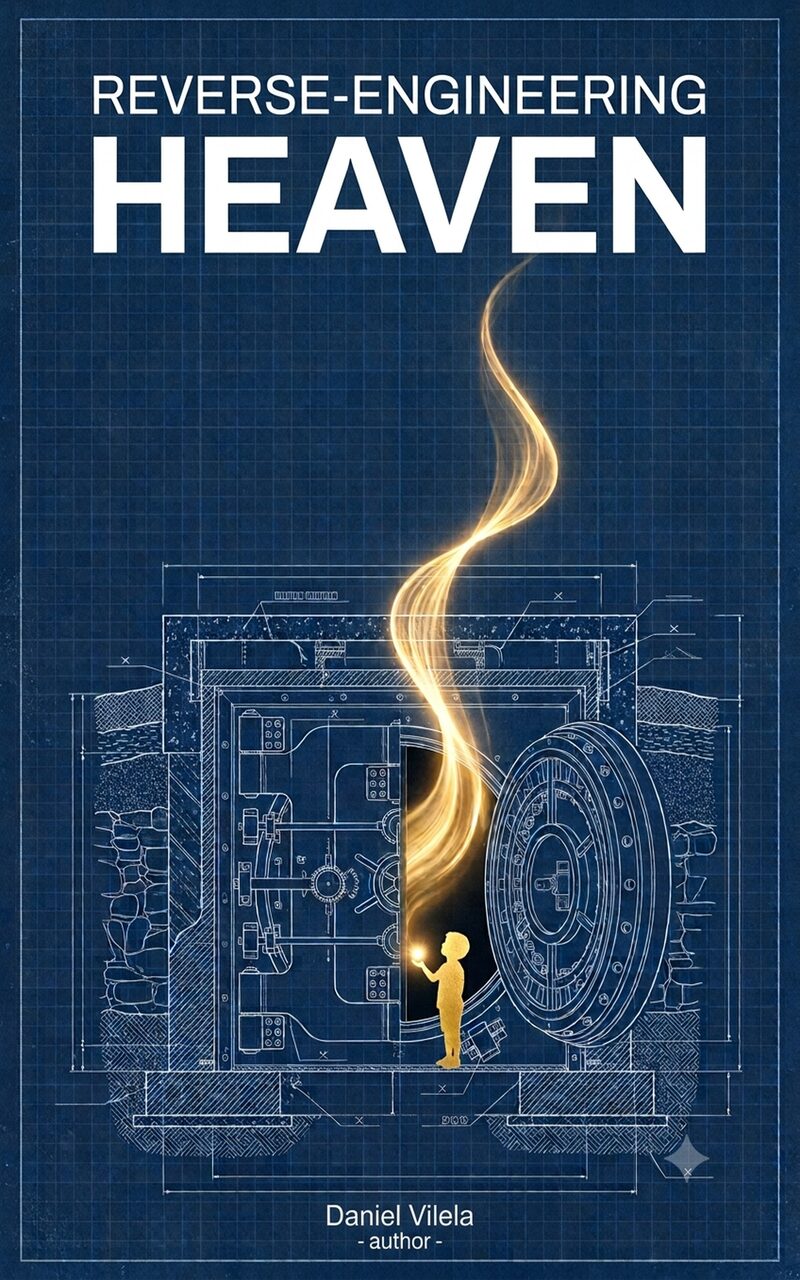
A rational cosmology of exile, healing, and the way home.
AUTHOR: Daniel Vilela
FORMAT: Kindle ebook
LENGTH: ~24,700 words
STORE: amazon.com
This book was not written by a mystic. It was written the way an engineer debugs a system:
by refusing every explanation that doesn't survive scrutiny, keeping the ones that do, and
testing the assembled model against reality until it either breaks or holds.
The subject happens to be the oldest one there is — what God is, why life hurts,
why we lose ourselves, and how we come back.
It has answers, but they arrive encrypted — in parable, ritual, and dogma — and the
encryption has a cost: rational people bounce off it. They hear sin and
surrender and heaven and conclude, reasonably, that this is machinery
for controlling the credulous. Often they're right.
The self-help shelf
It is very good at coping, and coping is what it sells. It hands you techniques for
managing a life you never agreed to, without ever saying what the pain is for —
which is why what it fixes does not stay fixed.
Underneath the control machinery there is a system description, and the system is real.
This book derives it the way you'd reverse-engineer any black box: observe the behavior,
hypothesize the architecture, test against the edge cases that break every comfortable
model — death, injustice, trauma, meaninglessness — and keep only what survives.
WHAT IS IN IT
PART I
THE SYSTEM
Derives the architecture from first principles: why a complete thing would create at
all, why forgetting is a feature rather than a flaw, and why pain is telemetry rather
than punishment.
PART II
THE MACHINERY OF EXILE
How a child hides the realest parts of himself. How a single sentence from a trusted
adult installs itself as an unquestionable axiom and runs for decades. How damage
propagates through a family without requiring a single villain.
PART III
THE RETURN PROTOCOL
A repair procedure, and it is not comfortable. It turns on one operation the culture
barely teaches: grief — not for the dead, but for the life you were not given, which is
the only thing that closes the account. Retrieval, reparenting, the difference between
coping with a desert and crossing it, and the stage nobody talks about: what to build
once you're out.
PART IV
THE STAKES
Tests the whole model against the hardest cases — death, injustice, and your own
objection that the design looks rigged. Then it answers the question the title has been
holding.
THE ANSWER THE TITLE HAS BEEN HOLDING
Heaven, defined here, is living as a child while being an adult. Everyone loses
that child; only some are robbed of it early enough to notice. The ones who go back and get
it do not recover twelve years of childhood. They recover it for the rest of their lives.
You can be whole regardless of the cards you were dealt.
Not compensated. Not coping well. Whole. The book does not ask you to believe
that — it asks you to run the experiment.
SPECIMEN PASSAGES
The guard is not the enemy. The guard is a loyal soldier who was posted at the door
decades ago and never told the war ended.
Chapter 6 · The Vault
Pain is not penalty. It is telemetry — information about distance from the
frequency. Nobody punishes you for touching a hot stove; the burn is data about where
your hand is.
Chapter 4 · Free Will and the Physics of Pain
That laugh is the frequency. It was never lost. It was guarded, by the bravest part
of you, until you came back for it.
Epilogue · The Handoff
CHECK THE THINKING BEFORE YOU SPEND ANYTHING
The schematics on this site are a figure from the book, built out. Aurea draws the felt
states it calls compounds as an assembly stack, and assays the counterfeits that fake
them — pity for compassion, submission for forgiveness, relief for joy. Nothing here is
gated, and there is no email wall. Read the sheets. If the thinking doesn't hold, you have
lost nothing.
Daniel Vilela is not a mystic, not a therapist, and not a guru. He is an engineer — one
who hit a problem his toolkit could not solve, and refused to stop debugging until it could.
This book is the log of that work. There is no course behind it, no retreat, no inner
circle; the method is all here, and the door was never locked. Take the insight and leave —
that is the test the book itself taught you. He is home.
WHAT THIS IS NOT
Not therapy
A work of philosophy and personal account, not medical or psychological advice. It
discusses psychiatric medication in Chapter 11 without telling anyone to start, stop, or
change a prescription — those decisions belong to you and your doctor.
Not a funnel
No course, no retreat, no inner circle, no upsell, no list to join. The book is the
whole product, and this site is free.
Not scripture
Question this book. All of it. Test each claim against your own walking; keep
what survives contact with your life; discard the rest without apology. Belief was never
the request — the request, from the first chapter to this page, was: run the
experiment.